Challenging yet compelling:
QMill’s quantum circuits at Junction Quantum Hack 2026
A full weekend of quantum problem-solving in Espoo ended with strong results and creative approaches. At Junction Quantum Hack 2026, Team hell0 from Aalto University won the grand prize of the hackathon. They also won QMill’s challenge by a slim margin, cracking only one more quantum circuit than the second-place team. Their result says a lot about what can happen when a capable team learns fast and works well under pressure.
June 9, 2026 - In this article:
- QMill Challenge at the pioneering Quantum Hack: Exciting times!
- Interview with the winners: Team hell0 had an excellent weekend
- Pictures about the QMill Challenge winners
QMill Challenge at the pioneering Quantum Hack: Exciting times!
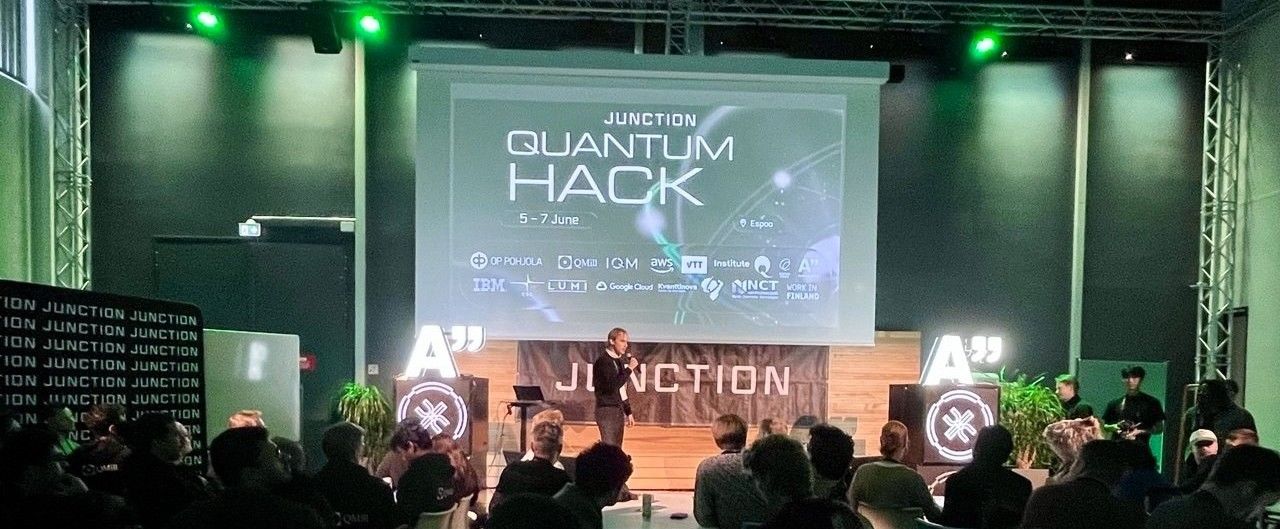
The Junction Quantum Hack 2026 brought together around 150 researchers, developers, students and other curious builders from more than 30 countries in Espoo, Finland, for a 48-hour quantum-focused hackathon in the first weekend of June.
The idea of the event was clear: bring people with different backgrounds into the same room, give them access to real quantum technologies and practical challenges, and see what they can build in a short and intensive format. Participants worked with quantum algorithms, real quantum computers and high-performance computing resources throughout the weekend.
The QMill challenge attracted many teams
QMill participated in the hackathon as both a challenge partner and a tech partner in cooperation with Amazon Web Services and CSC Lumi Supercomputer. For the event, QMill built quantum circuits that hide secrets and challenged participants to find ways to extract them. Teams engaged with the QMill platform, earning more and more points by solving more and more difficult problems.
“I was positively surprised by the number of teams participating in our challenge. Even more so when I saw on Saturday morning that most of the hard problems had already been cracked. That was especially impressive given the limited time and computational resources,” says Clayton Leite, Quantum AI Engineer at QMill, part of the QMill challenge jury and the mastermind behind the circuits used in the challenge.
Even though some teams were quick with their initial submissions, work on the more difficult problems continued until the last minute.
“When I arrived at the event at 8AM on Sunday morning, I was pleasantly surprised to see so many teams still chipping away at our problems. Before I could even get a cup of coffee, several teams excitedly approached me with insightful technical questions, showing that they really had put a lot of effort into cracking our circuits. With us offering a more technical challenge than the other partners, it was hard to predict the level of interest, but the engagement exceeded our expectations, and we received invaluable technical feedback on our methods for generating interesting quantum circuits. Hopefully some of the participants continue this interesting work at QMill someday!” says David Karpuk, Principal Quantum Algorithm Engineer at QMill and chief judge of the QMill challenge.
QMill challenge winners were all among the five finalists of the entire Quantum hack
On Sunday early afternoon at the closing ceremony of the Quantum Hack, five finalist teams chosen by their peers had a chance to present their pitches to the jury and to compete for the grand prize of the hack. Three of the teams had worked on QMill’s challenge problems and the other two on the OP Pohjola and IQM challenges.
Altogether 15 teams submitted results for the QMill challenge and the three best ones were awarded by QMill:
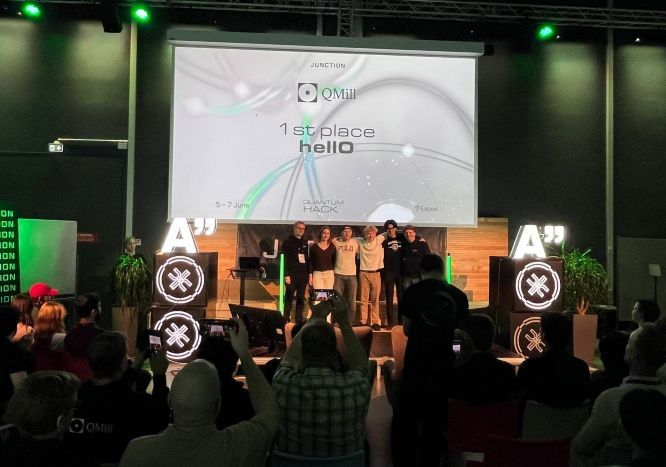
- The winning team, hell0, managed to crack 41 out of the 49 challenge circuits using only their laptops. That is, every circuit except the very hard ones. They also came up with interesting insights and showed interest in continuing to work on the very hard circuits that remained uncracked.
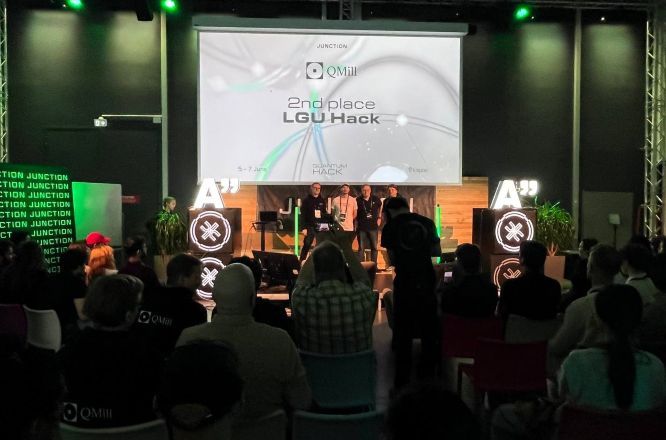
- LGU Hack came in second place. They had an impressive start, as they had already cracked 40 out of the 49 circuits by Saturday morning. However, there was one circuit that their methods could not solve, which ultimately left them just behind the winners.
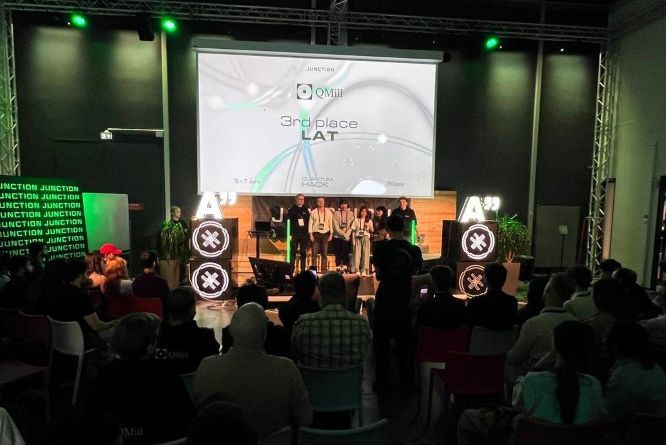
- Team LAT secured third place with a strong overall performance.
“It seemed to me that most participants had little to no prior knowledge of quantum computing. However, the challenge demonstrated that AI stress testing can contribute a lot when evaluating how robust the circuit designs are,” Clayton concludes.
“The pioneering Junction Quantum Hack 2026 clearly exceeded our expectations. QMill congratulates all the winners and thanks all participants, fellow challenge and tech partners, and Junction. We definitely shared the excitement! We are also pleased to see so many new users joining the QMill Quantum Advantage Services platform and their very good feedback,” says Janne Heikkinen, Chief Product Officer at QMill.
Interview with the winners: Team hell0 had an excellent weekend
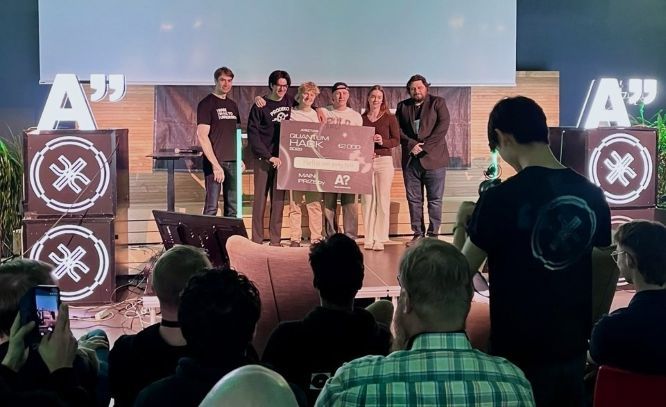
Team hell0 from Aalto University won the main prize of the entire hackathon and placed first in the QMill challenge. Their QMill win was a close one: the gap to the second team was only one solved task.
What makes their story especially interesting is that the team did not come into the event with a deep background in quantum computing. Much of their result came from learning quickly, dividing the work well and focusing on methods they could apply within the time available.
When asked how the QMill challenge felt at the start, Victor Ocampo, a first-year Industrial Engineering and Management student at Aalto University, said the team had not planned to focus on it from the beginning.
“We started with the OP challenge, but there were four of us, so we thought we could also spend some time on QMill. At first we were honestly a bit worried about what we had got ourselves into, because the QMill problems looked very technical. We do have a solid background in maths and physics, but nothing at PhD level. Still, after a while our way of approaching the problems started to work.”
Anni Tapionlinna, a second-year Industrial Engineering and Management student at Aalto with a background in mathematics, coding and science competitions, said the QMill challenge caught their attention early on. “The QMill problems were really interesting. They were a bit different from the other challenges, and that made us want to work on them. Solving them took a lot of time, though.”
Because the team did not have time to build deep theoretical understanding over one weekend, they had to be practical in how they worked. When asked how they approached that limitation, Touko Ursin, a first-year Industrial Engineering and Management student at Aalto with a software background from a startup, said they focused on learning just enough to move forward.
“We knew from the start that we could not go very deep in only 48 hours. So we tried to learn which methods worked for which kinds of problems. It was enough to understand the ideas at a high level. We focused a lot on managing AI agents, and during the weekend we learned how these things can be done.”
Another question is why they decided to join a quantum-focused hackathon in the first place, despite not coming from a quantum background.
Manu Mäkinen, who studies mathematics and physics at Aalto and also has a software engineering background, said the reason was simple: they wanted to challenge themselves with something new.
“Many of us go to hackathons, and when I saw the announcement, I asked my friends if we should join. It sounded like something new and interesting. Quantum technology is also a very current topic.”
The team said that it was cool to get a chance to use the infrastructure and get a view of the quantum ecosystem. Overall, the hack lowered the stress hold on quantum matters.
Looking back, one of the most striking parts of hell0’s weekend was how quickly they were able to learn. In QMill’s challenge, they managed to solve more of the quantum circuit puzzles than any other team. The final difference to the runner-up was only one task, but that was enough to secure first place.
QMill challenge winners: